
 Try Humy for free




Dr. Michael Calvert
Assistant Superintendent, South Allegheny School District, Pennsylvania
Been using Humy in his district since 2024
“We enjoyed the program last year and used it frequently.”

Cleopatra
69–30 BCE

Socrates
c. 470–399 BCE

George Washington
1732–1799

Marie Curie
1867–1934

Nelson Mandela
1918–2013

Hatshepsut
c. 1507–1458 BCE

Frida Kahlo
1907–1954

Mahatma Gandhi
1869–1948

Joan of Arc
c. 1412–1431

Leonardo da Vinci
1452–1519

Harriet Tubman
c. 1822–1913

Confucius
551–479 BCE

Napoleon Bonaparte
1769–1821

Wu Zetian
624–705

William Shakespeare
1564–1616

Mansa Musa
c. 1280–1337

Ada Lovelace
1815–1852

Abraham Lincoln
1809–1865

Hammurabi
c. 1810–1750 BCE

Simone de Beauvoir
1908–1986

Genghis Khan
c. 1162–1227

Rosa Parks
1913–2005

Marcus Aurelius
121–180

Elizabeth I
1533–1603

Frederick Douglass
c. 1818–1895

Galileo Galilei
1564–1642

Jane Austen
1775–1817

Martin Luther King Jr.
1929–1968

Hokusai
1760–1849

Winston Churchill
1874–1965
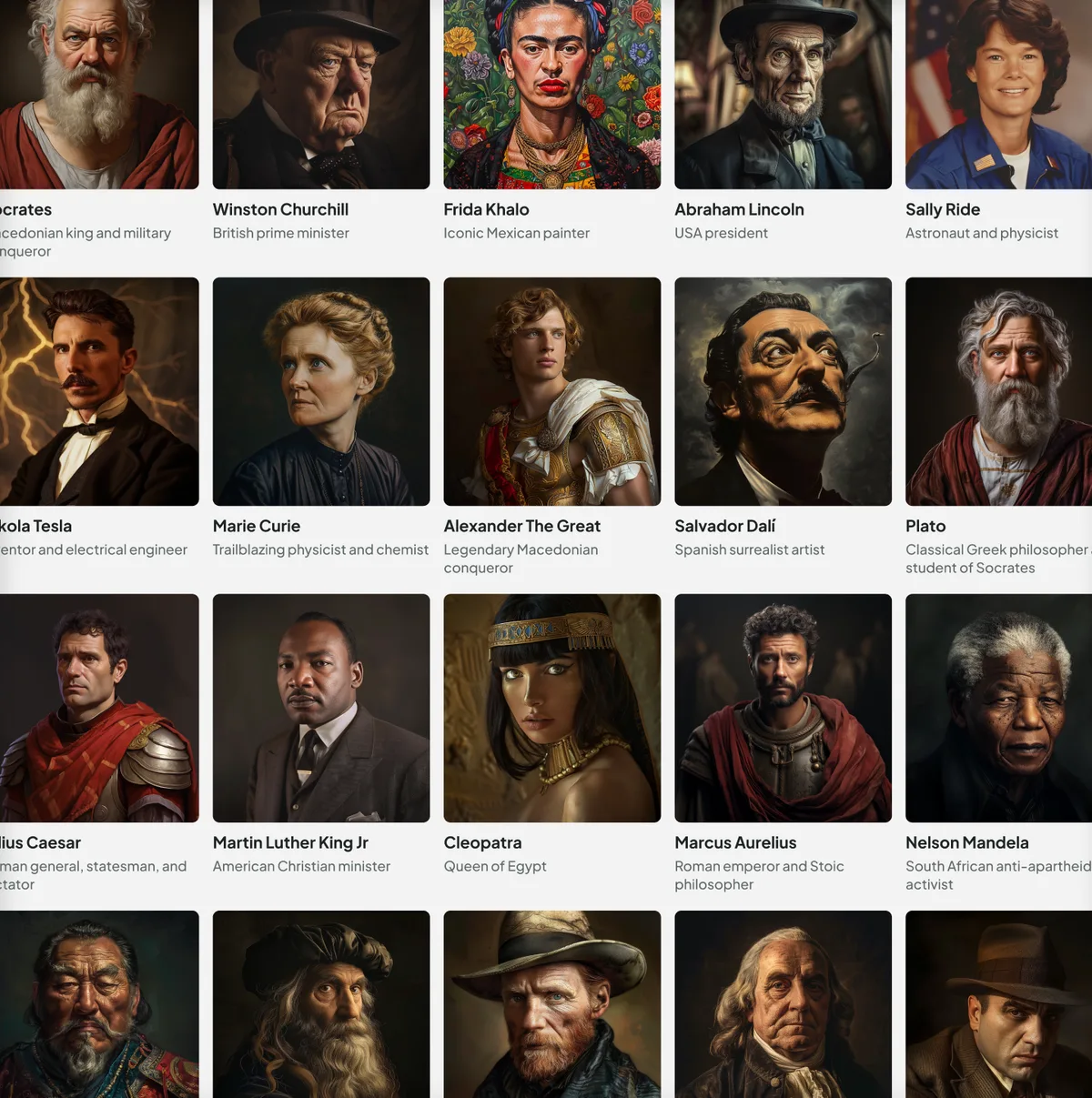
Interview 1,200+ historical figures, from Cleopatra to Churchill, who answer from real primary sources.
 Used by 90 schools, districts, and universities, with customers in 42 countries


























Also experts and coaches, publishers and libraries.
Every quote a figure gives is copied from a real document and opens the page, so whichever format you choose, in a classroom, a seminar or on your own, the argument is with the record rather than with a chatbot’s guess.
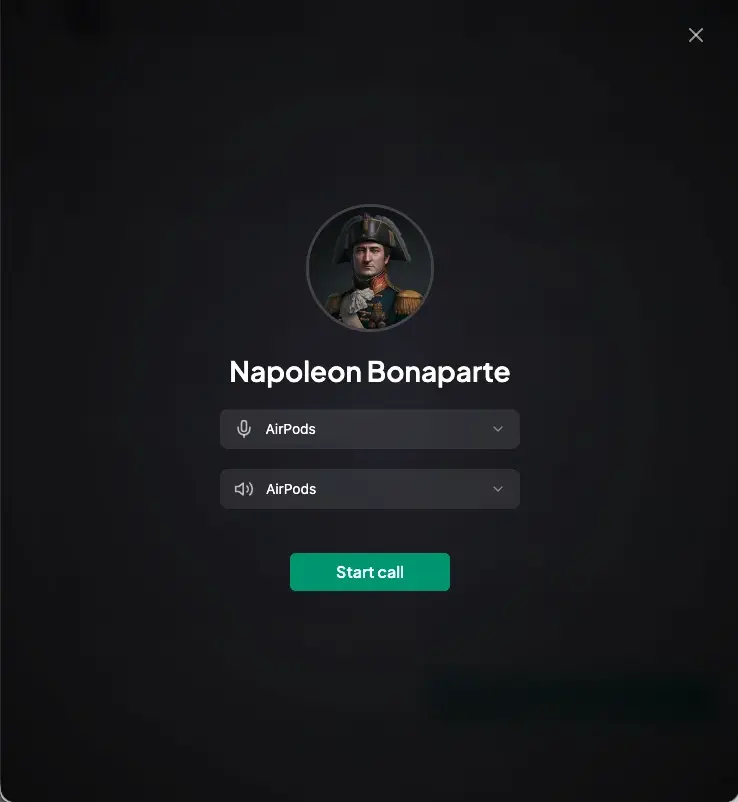
Students question an AI historical figure directly — practicing inquiry, active listening, and the follow-up reasoning that turns reading comprehension into real understanding.
Students build and defend an argument against one figure or a panel of up to ten, or set the motion and moderate while the panel argues it out. Either way they push past recall into evidence-based, higher-order thinking.
Students step into a role and make decisions inside the moment, developing empathy and perspective by living the situation rather than reading about it.
Short-answer and open-ended prompts, each with a model answer you define and a set number of attempts, so students reason on the page and revise toward mastery.
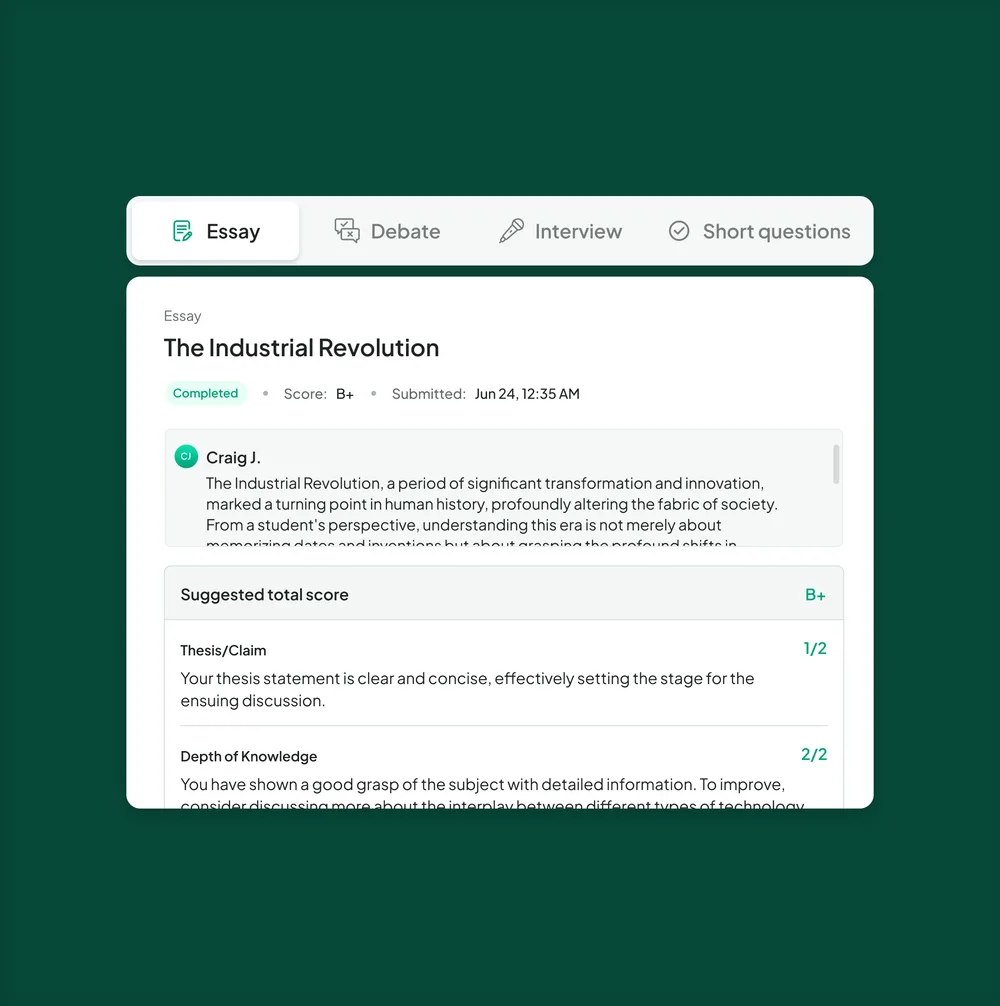
Document-based and long-form writing scored against your rubric — the analytical writing your standards already ask for, generated and graded in minutes.
Interview, Debate and Simulation can also run as a panel: up to ten figures in one group chat, moderated by the student. See a panel at work ↓
US state standards, C3, AP and IB, and international frameworks, from primary school through university.
Custom criteria and performance levels, auto-scored with written feedback.
Any quote a figure gives is copied from the document and opens the page. The AI never writes one.
Set the reading level for each class or group, from primary school through university and adult learners.
New · Panels
A panel puts up to ten AI historical figures in one group chat, and your student runs it. Comparing two sides of the past used to mean two browser tabs and a notebook. Now the sides answer each other, and the student decides who gets the floor. The exchange shown is one American motion. Seat Luther against Calvin, or Keynes against Hayek, and the panel runs the same way.
In a class debate, the same three students do most of the talking. With panels, every student gets a debate of their own.
Two ways to debate
On every plan. Each figure that answers uses one message from your pool.
Panel · 5 figures
Moderator · Motion
The colonies should declare independence.

Thomas Paine
Reconciliation is a dream this continent has woken from. Look at a map:
“…there is something very absurd, in supposing a continent to be perpetually governed by an island.”

Edmund Burke
Mr. Paine mistakes a quarrel with the King’s ministers for a quarrel with England. I put the remedy to the Commons in four words:
“The proposition is peace.”
Your Majesty, why did the colonists’ last petition go unanswered?

King George III
Because a petition does not excuse an army in the field. I told Parliament what this war is for:
“…manifestly carried on for the purpose of establishing an independent empire.”
Moderator
Mr. Paine, the King says this is about empire, not liberty. Is he wrong?
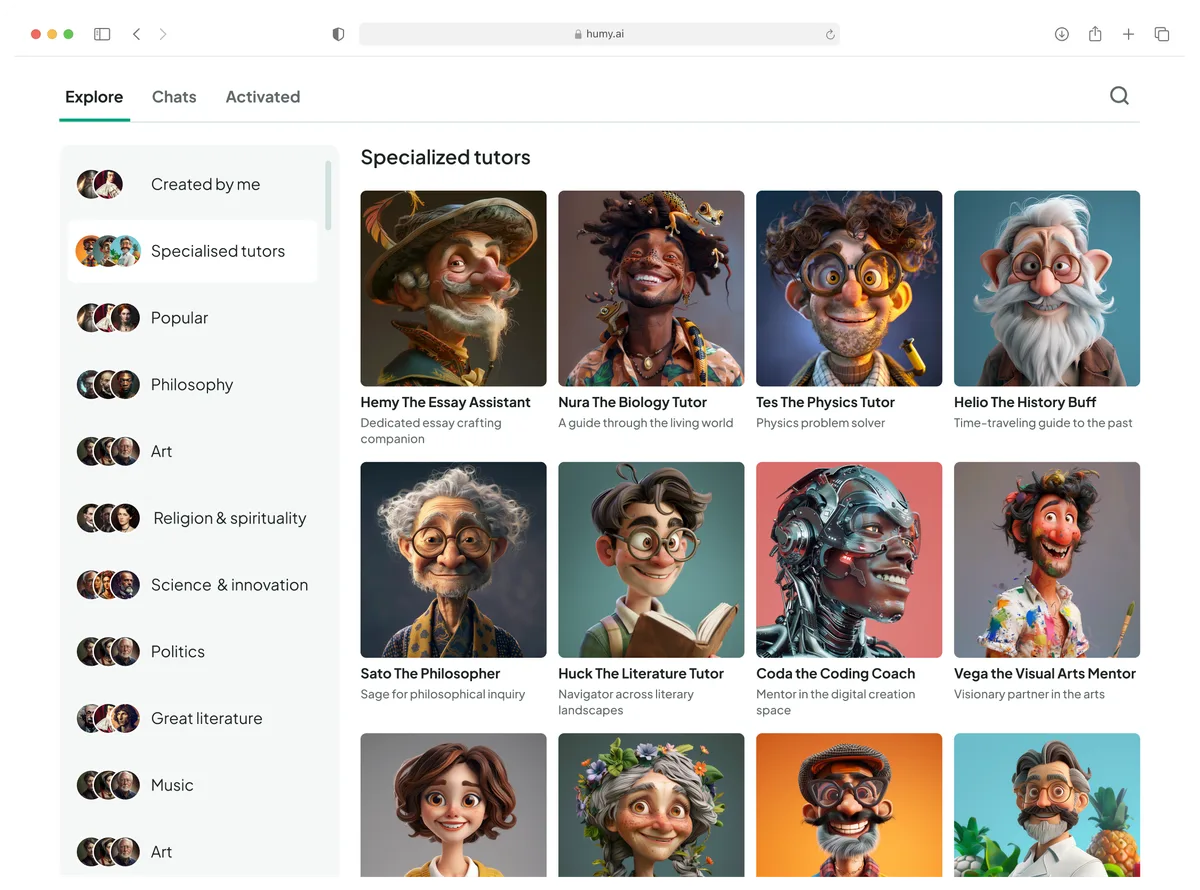
Pick two to ten figures for an interview, debate or simulation, or let the AI choose them for your topic. Figures you built, or ones other teachers shared, can sit on it too.
They put a question to the whole panel or to one figure by name, and choose who answers next. When a claim needs testing, they step in as moderator.
Switch to Discuss and the figures argue the point among themselves for as many lines as you allow, up to 20. The student can stop them or cut in at any point.
The rubric scores only the student’s lines: in a panel debate, the motion they set and how well each interjection steers the panel. Burke can argue beautifully. It earns the student nothing.
Rules every panelist is given
Dr. Michael Calvert
Assistant Superintendent, South Allegheny School District, Pennsylvania
Been using Humy in his district since 2024
“We enjoyed the program last year and used it frequently.”

Jacob Chisom
World and American History, Monticello High School, Arkansas
Been using Humy in his classroom since 2024
“My students say it’s a welcome change of pace. I’m not a fan of the “sage on the stage” model, so I try to incorporate research-oriented and self-paced activities. With Humy, students have to take charge of their learning. They’ve become more adept at critical thinking, forming better questions, and improving their reading comprehension. The interview feature has been my go-to tool. I create assignments where students must ask historical figures a set number of questions, then summarize the responses to ensure they’re truly absorbing the material. This approach lets them actively explore the past rather than passively consuming information.”
Roger Campbell
7th-grade World History, Lancaster County, Pennsylvania
Been using Humy in his classroom since 2024
“Humy has helped me bring historical figures, sometimes long past, to life. When my students interact with these figures in real-time, it eliminates some of the perceived “ancient” characteristics of my curriculum. This has shifted my students’ thinking away from viewing history as abstract or irrelevant. Real-time interactions make historical figures relatable, even allowing students to ask off-topic questions that help put historical lives in a more relevant context for 13-year-olds. The feature I use the most is the interview feature. After teaching a topic, most recently Gandhi and Joan of Arc, I have the students ask pointed, focused questions. We practice good conversation techniques beforehand, teaching them to listen (or read) carefully and formulate thoughtful follow-up questions rather than just interrogating. It helps students practice effective conversation skills.”

Paul Lepore
Social Studies Department Chairperson
“Through Humy’s dynamic platform, students engage in inquiry-driven explorations, where they not only interact with historical personas but also unearth leads to primary and secondary documents.”

Melissa Vanicky
Educator, Staten Island International School, NY
“Humy’s user-friendly platform has enhanced my students’ engagement and understanding of history. It helps them develop critical thinking and engage in insightful discussions.”

Jasper Nordling
Educator, Berghs School of Communication
“I introduced Humy as part of my student project and was surprised by the high level of engagement from my students. It added completely new dimensions to the project.”

Matthew Kreis
American History Teacher
“Humy revolutionizes education with personalized learning, tailored instruction, and enhanced student engagement. It fosters an interactive classroom, allowing hesitant students to confidently participate by engaging with historical figures like Frederick Douglass. Outstanding!”
Frank B.
8th Grade History Teacher, California
“Humy saves me 4 hours per week on grading, and the feedback students receive is awesome. I really like it. I showed it to my principal, and he was blown away by it. The feedback part is really awesome.”

Educational App Store
Independent Editorial Review
“For young learners especially, the first task of a history teacher is to inspire interest. We’d argue that allowing them to chat with Lincoln will do that better than giving them a printed sheet of facts.”
Dr. Michael Calvert
Assistant Superintendent, South Allegheny School District, Pennsylvania
Been using Humy in his district since 2024
“We enjoyed the program last year and used it frequently.”
Jacob Chisom
World and American History, Monticello High School, Arkansas
Been using Humy in his classroom since 2024
“My students say it’s a welcome change of pace. I’m not a fan of the “sage on the stage” model, so I try to incorporate research-oriented and self-paced activities. With Humy, students have to take charge of their learning. They’ve become more adept at critical thinking, forming better questions, and improving their reading comprehension. The interview feature has been my go-to tool. I create assignments where students must ask historical figures a set number of questions, then summarize the responses to ensure they’re truly absorbing the material. This approach lets them actively explore the past rather than passively consuming information.”
Roger Campbell
7th-grade World History, Lancaster County, Pennsylvania
Been using Humy in his classroom since 2024
“Humy has helped me bring historical figures, sometimes long past, to life. When my students interact with these figures in real-time, it eliminates some of the perceived “ancient” characteristics of my curriculum. This has shifted my students’ thinking away from viewing history as abstract or irrelevant. Real-time interactions make historical figures relatable, even allowing students to ask off-topic questions that help put historical lives in a more relevant context for 13-year-olds. The feature I use the most is the interview feature. After teaching a topic, most recently Gandhi and Joan of Arc, I have the students ask pointed, focused questions. We practice good conversation techniques beforehand, teaching them to listen (or read) carefully and formulate thoughtful follow-up questions rather than just interrogating. It helps students practice effective conversation skills.”
Paul Lepore
Social Studies Department Chairperson
“Through Humy’s dynamic platform, students engage in inquiry-driven explorations, where they not only interact with historical personas but also unearth leads to primary and secondary documents.”
Melissa Vanicky
Educator, Staten Island International School, NY
“Humy’s user-friendly platform has enhanced my students’ engagement and understanding of history. It helps them develop critical thinking and engage in insightful discussions.”
Jasper Nordling
Educator, Berghs School of Communication
“I introduced Humy as part of my student project and was surprised by the high level of engagement from my students. It added completely new dimensions to the project.”
Matthew Kreis
American History Teacher
“Humy revolutionizes education with personalized learning, tailored instruction, and enhanced student engagement. It fosters an interactive classroom, allowing hesitant students to confidently participate by engaging with historical figures like Frederick Douglass. Outstanding!”
Frank B.
8th Grade History Teacher, California
“Humy saves me 4 hours per week on grading, and the feedback students receive is awesome. I really like it. I showed it to my principal, and he was blown away by it. The feedback part is really awesome.”
Educational App Store
Independent Editorial Review
“For young learners especially, the first task of a history teacher is to inspire interest. We’d argue that allowing them to chat with Lincoln will do that better than giving them a printed sheet of facts.”
Try Humy in your next lesson, seminar or chapter
Free plan, 20 messages a month, no credit card · students join with a link, no accounts to set up
Average time a teacher saves each week on grading and lesson planning with Humy
To generate a complete assignment or lesson plan
Of the 60 middle-school students we surveyed said they want to use Humy every week
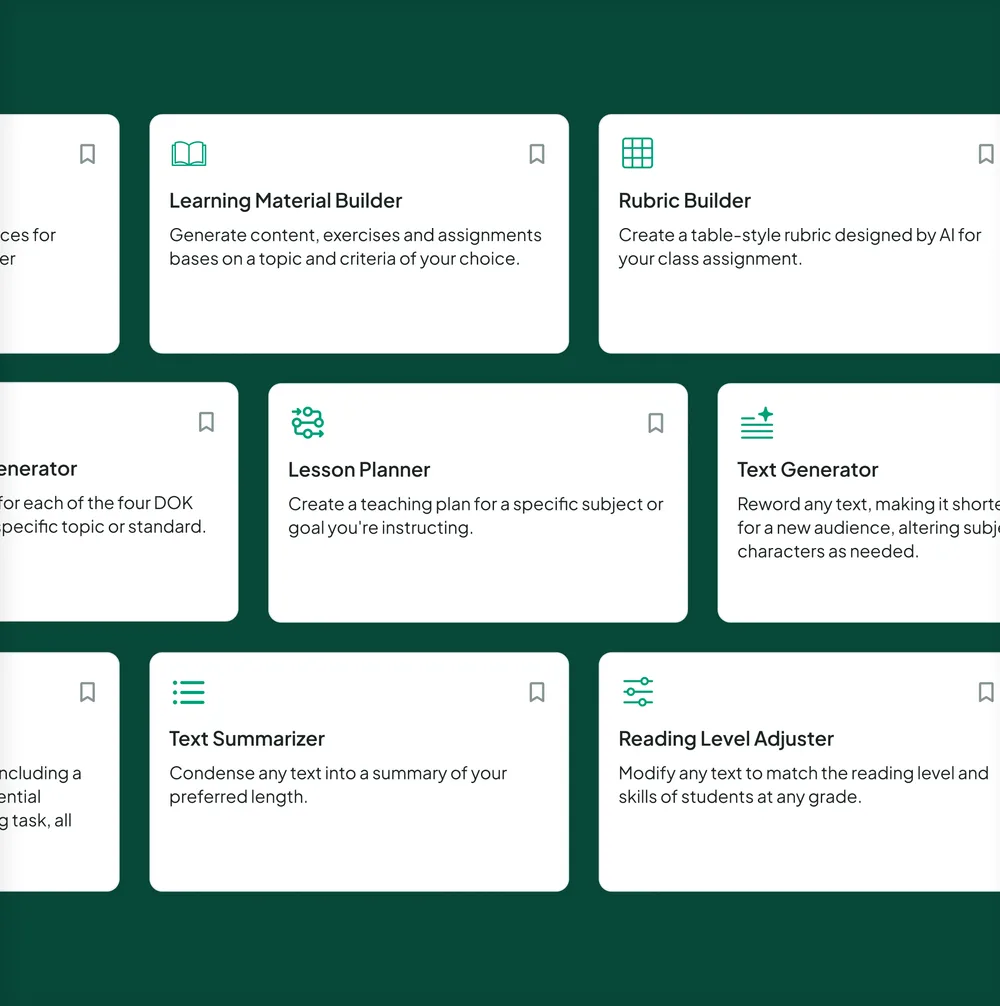
Teachers on Humy can now share what they build with every other teacher on the platform. Look under Community in your library. Each item shows who shared it, so you can email them and ask how it went in their class.
One teacher’s unit, as you would find it
A Lowell mill worker, 1845
Custom figure · ages 13–14
Loom and Spindle, or Life Among the Early Mill Girls
Harriet H. Robinson, 1898 · transcript included
Did the mills set women free?
Debate · panel of 4 · ages 13–14
The Market Revolution, 1815–1850
6 figures
Illustrative · the real library is public
Each item has its own setting: Only me, My school, or Everyone on Humy.
An AI checks the text and images of every shared item before another school can see it. Nobody at Humy approves items first, so any teacher can report one, and we take down what breaks the rules.
Students can’t browse the library. A shared figure or assignment reaches them only through your own link, and without its author’s name.
AI models
Choose from 9 chat models for every figure you share, from quick and light on your plan to the deepest reasoning available.
OpenAI
Anthropic
Getting a new tool past IT and procurement is usually the slow part, whether your school answers to a US district or to the GDPR. Humy is built by a Swedish company; student data is stored on Microsoft Azure in the United States or in Sweden, and the platform is FERPA and GDPR aligned. We give you the paperwork already prepared:

Updated in 2026. Have more questions? Contact us.
Humy is a website where you hold in-depth conversations with AI recreations of more than 1,200 historical figures: ask Hammurabi or Marie Curie a question and get an answer back, in writing or out loud, in 50+ languages. A figure can be given an archive of primary sources (letters, speeches, scanned books, photographs), which it searches while answering. Every quote it shows is copied character for character from the document and opens the page, so you can read the passage in context; the AI never writes a quote. Schools and universities use Humy for assignments graded to a rubric, museums put figures in their exhibits, and private readers use it on their own. Nothing to install. Humy comes from the team behind the Hello History app (2022); Hello History for schools became Humy in 2023 (humy.ai/hello-history-for-schools).
No. History and social studies are where most teachers start, but the library holds 1,200+ figures across law, philosophy, religion, literature, economics, science and art: Hammurabi, Blackstone and Rawls; Socrates, Confucius and Avicenna; Shakespeare, Austen and García Márquez; Adam Smith and Keynes; Curie, Darwin and Al-Khwarizmi; Hokusai and Frida Kahlo. Every figure answers in 50+ languages, and text answers can carry images, formulas and tables, so Humy runs in law, philosophy, literature, language, science and ethics courses as readily as in history. If the person you need is missing, build them from your own documents; people on Humy have already built 20,000+ figures that way.
It works well beyond K-12. Reading level is set per figure version from primary school through university and adult learners, and the five assignment formats run unchanged in a seminar. Of our 648 paying customers, 92 are schools, 6 are universities, 375 are individual teachers, 19 are individual professors, 143 are private individuals and 13 are businesses. Museums and cultural institutions embed figures in their exhibits. Wherever people learn from sources, the platform fits.
Yes. Humy Technologies AB is a Swedish company based in Stockholm. Figures answer in 50+ languages by text and live voice. Student data is stored on Microsoft Azure in the US or in Sweden, and the platform is FERPA and GDPR aligned. 137 of our 648 paying customers are outside the US, and all told we have customers in 42 countries: schools in the UK, Germany, Hong Kong and Singapore, universities in Sweden, Switzerland and Austria, and individual teachers, professors and readers from Canada and Australia to Turkey, Poland, Mexico and Kenya. This website is in English for now. The product is not limited to it.
Build the figure on the texts you teach: a public-domain edition of Blackstone's Commentaries, the week's article, your own lecture notes. The figure searches those documents before it answers and returns quotes copied character for character from the page, each one opening that page. The AI never writes a quote. The surrounding prose is still generated and can still be wrong: in our August 2026 benchmark run on Napoleon, 1,323 quotes contained 0 fabrications, while about one answer in eight still carried an invented detail in the prose. We publish that number so you can set the exercise accordingly: the quotation is the evidence, the paraphrase is the claim your students have to test.
Yes, and 143 people pay to do exactly that. Humy began in 2022 as the Hello History app, and private readers are still part of it, with paying individuals in 31 countries. The free plan gives you 20 messages a month with no credit card; the personal plan is US$129 a year. Question any of the 1,200+ figures by text or live voice, or upload a public-domain memoir and interrogate its author. If you prefer a phone app, Hello History (hellohistory.ai) is our consumer app for chatting with historical figures on the go. Classes, assignments and school privacy agreements stay on Humy.
The free plan is 20 messages a month, no credit card. Individuals pay US$129 a year. School plans start at US$600 per school per year; universities get a quote at humy.ai/request-a-quote. Museums start with a 30-minute demo, booked from humy.ai/for-museums. Libraries, archives and publishers book a call from their own pages. Prices are in US dollars.
General chatbots improvise a persona and offer no guardrails for the classroom. A Humy figure searches the primary and secondary sources it is given, and any quote is copied from them, never written; you stay in control: you build assignments aligned to the standards you teach to, set a grading rubric, cap attempts, turn copy-paste off and choose the reading level for each group. Students join from a link or QR code with no account. That same structure applies in any subject: a chemistry interview with Curie, a literature debate, or a philosophy simulation all run through the same teacher controls.
Two different things, so two answers. A quote is never written by the AI: when a figure quotes, Humy's backend copies the passage character for character from the source document, and you can open the page it came from. In our published benchmark (a Napoleon figure, August 2026) that held for all 1,323 quotes; none was fabricated. The prose around the quotes is still the AI's. Loading the documents cut outright invention there from 22.6% of answers to 12.2%, which means about one answer in eight still carries a wrong date or detail. We publish those numbers at humy.ai/blog/humy-2-6-97-percent-increase-in-historical-reasoning. That is why every quote opens its page: so you can check, and so students learn to. The more documents a custom figure has, the better its prose gets, and you can give feedback to refine it.
For chat, Humy supports models from OpenAI, Anthropic, and Google: GPT-6 Luna, GPT-6 Sol, GPT-6 Astra, GPT-OSS 120B, Claude Sonnet 5, Claude Opus 5.5, Gemini 3.8 Flash, Gemini 3.1 Pro, and Gemini 3.5 Flash Lite. Live voice calls run on Gemini 3.8 Live. You decide per figure version which of these students can use in chat and which one is the default, so a large class can run on a faster, cheaper model while an advanced seminar gets a more capable one. Faster models use fewer credits, which keeps a class set of conversations affordable.
Five formats: interview, debate, historical simulation, open questions (open-ended or short-answer), and essay, including the US AP essay types (DBQ, LEQ, FRQ) and concept-application prompts. You set the level from primary school through university and lifelong learners, the language, and the standards, whether US federal and state, or international. The formats are subject-agnostic, so you can debate an ethical question in philosophy, interview a scientist for a lab unit, or assign a free-response essay in any AP-level course, not only history. Interviews, debates and simulations can run with one figure or with a panel of up to ten.
Yes, in a panel: two to ten figures in one group chat. You set one up when you build an interview, debate or simulation, or by adding guests to any figure's share link, and the AI can pick the figures for your topic. Students ask the whole panel or one figure by name and choose who answers next. In Discuss mode the figures argue the point among themselves, for as many lines as you allow (20 at most), while the student moderates. Grading looks only at what the student wrote. Each figure that answers uses one message from your pool.
Yes. Humy generates a rubric with criteria and performance-level descriptors, grades submissions against it automatically, and writes feedback for each student that you can review and adjust. You decide whether grading is on, how many attempts students get, whether they see the rubric in advance, and whether copy-paste is allowed. The same rubric grading works for a science explanation, an English essay, or a world-language task.
Students can type or start a real-time voice call, and any written answer can be played back as speech. Voice suits auditory learners and accessibility, and because Humy supports 50+ languages it also serves as conversation and pronunciation practice in world-language classes. Images and rich formatting appear in text mode rather than during voice calls.
More than 50, in text and in live voice. The app ships 42 base languages, including Arabic, Bengali, Chinese, German, Spanish, French, Hindi, Indonesian, Japanese, Korean, Portuguese, Russian, Swedish, Turkish and Vietnamese, and a figure can hold the whole conversation in any of the 50+. A quote is copied from its document character for character, so it stays in the language it was written in. Voice calls are capped at ten minutes each; images and tables appear in text mode only.
You share each activity as a link, a QR code, or an embedded iframe, and you choose whether students join anonymously or enter their name. QR codes suit exhibitions and classroom stations, links suit assigned work, and the iframe drops Humy straight into your LMS or a public website. The same options support a museum exhibit, a science station, a poetry corner, or a language lab, with no student accounts required.
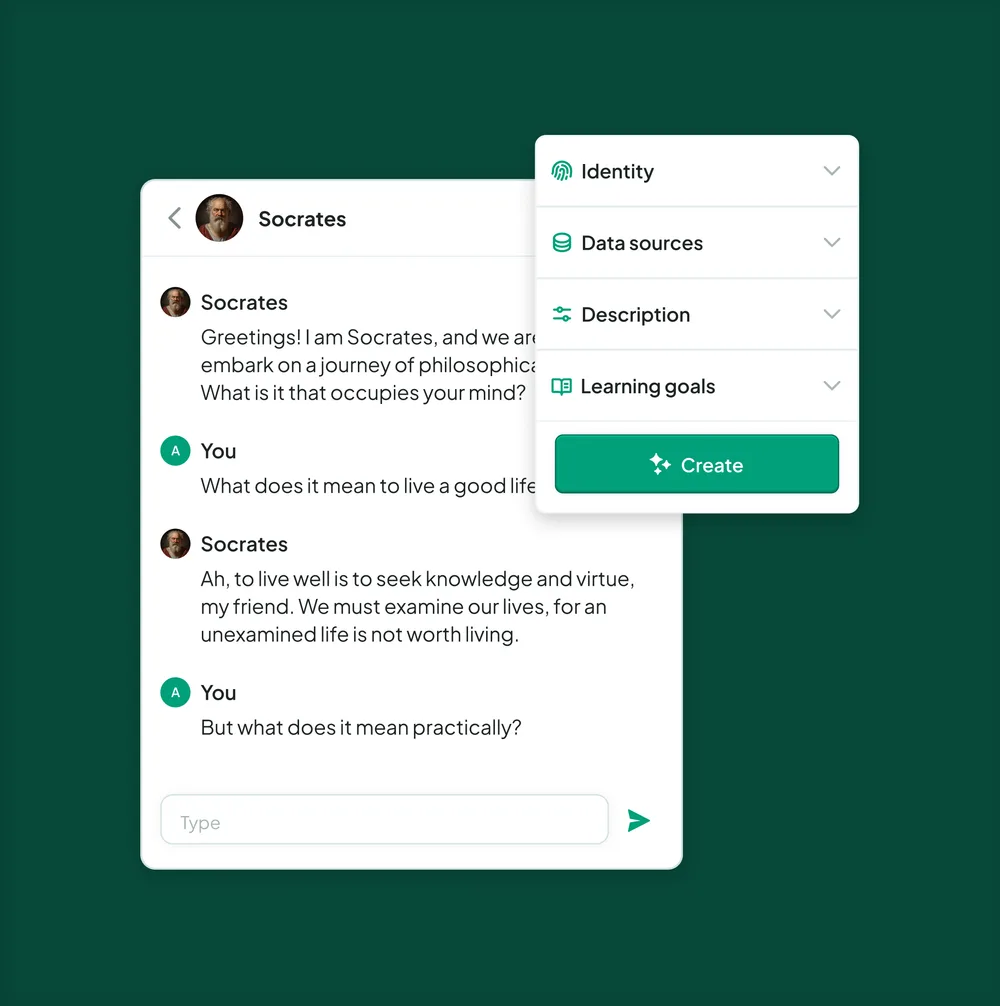
Yes. You can create your own AI figure from a name, a short biography, and your own documents and artefacts in text, image, and video, and people on Humy have already built more than 20,000 of them. Make a cell-biology coach, a guide to a specific novel, a museum curator, or a subject expert, then add instructions such as 'use Socratic questioning' or 'focus on the experiments.' For larger projects, our team also builds tailor-made figures for schools, universities, and museums.
Yes. Teachers can share what they build with every teacher on Humy, and you'll find it under Community in your library. You can chat with a shared figure, make your own version of it, or put it on a panel. A shared source goes into your own sources with its transcript. Assignments copy over for you to edit before you assign them, and collections are one Activate button away. An AI checks the text and images of every shared item before other schools can see it. Nobody at Humy approves items first, so if something slips through, report it and we'll take it down.
You decide item by item: Only me, My school, or Everyone on Humy. Teachers at other schools can use a shared figure without seeing its instructions or sources. They can copy a shared assignment, but student submissions never leave your account. They do see your email, so they can contact you. Shared assignments and collections can also appear in the public library on humy.ai, without your name. Students never see who made what.
Each figure can have several versions. You set the reading level from primary school through university and lifelong learners, add instructions like 'speak in Spanish' or 'focus on the scientific method,' and share each version separately so different groups get the right fit at the same time. Teachers use this to level a science text, run one lesson in two languages, or differentiate across a mixed-ability English class.
No. You share a chat as a web link or QR code, and students open it and start talking — no sign-up and no password. You choose whether they join anonymously or enter their name.
Email us at hello@humy.ai with your school administrator's name and email address, and we will take it from there.
Yes, we are happy to submit vendor paperwork. Please reach out to hello@humy.ai.
Yes. You can add several teachers to one account; the price depends on how many teachers you invite.
Yes, please reach out to hello@humy.ai
 Try for Free
 A student data privacy agreement, already signed in 16 US states, covering how student data is handled


